
Safe lock help · LA GARD (dormakaba)
Safe lock troubleshooting › LA GARD (dormakaba) › LA GARD 5715 / 5750 / 5750-K keypad
The LA GARD 5715, 5750 and 5750-K are round keypads with a slanted key panel and two light-bulb keys that turn on the key backlight. They work with LA GARD electronic locks (ComboGard Pro, AuditGard and Basic). This guide covers how to open the lock, change the combination, replace the 9-volt battery behind the small door at the bottom, and what the signals mean.
Want the whole manual? Jump to the manufacturer download links.
Is this your lock?
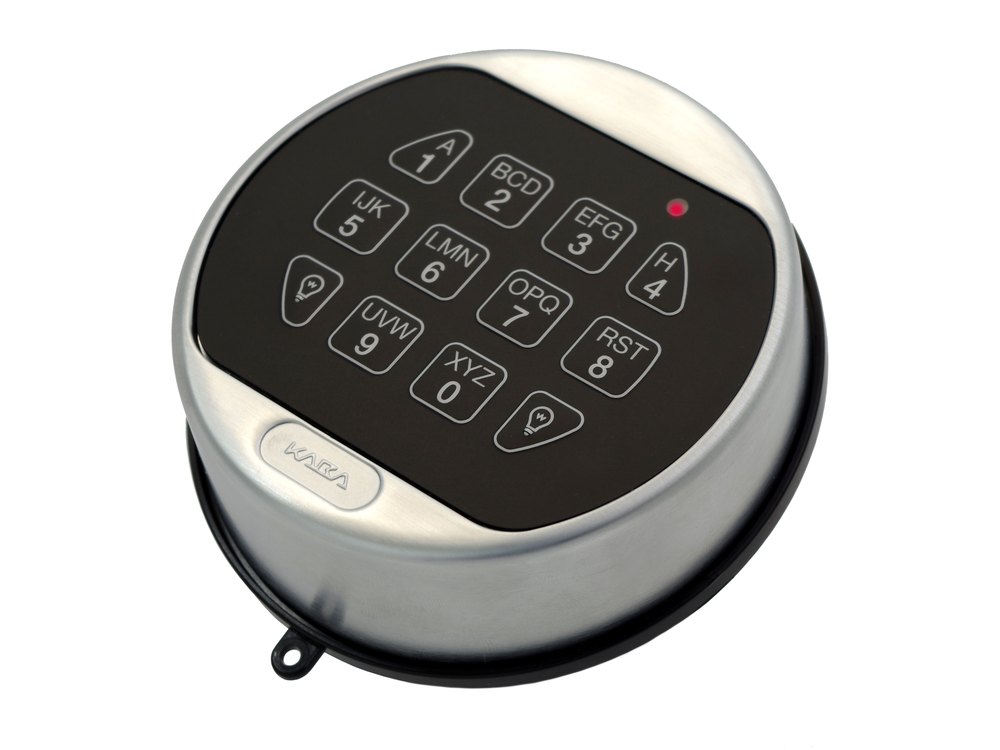
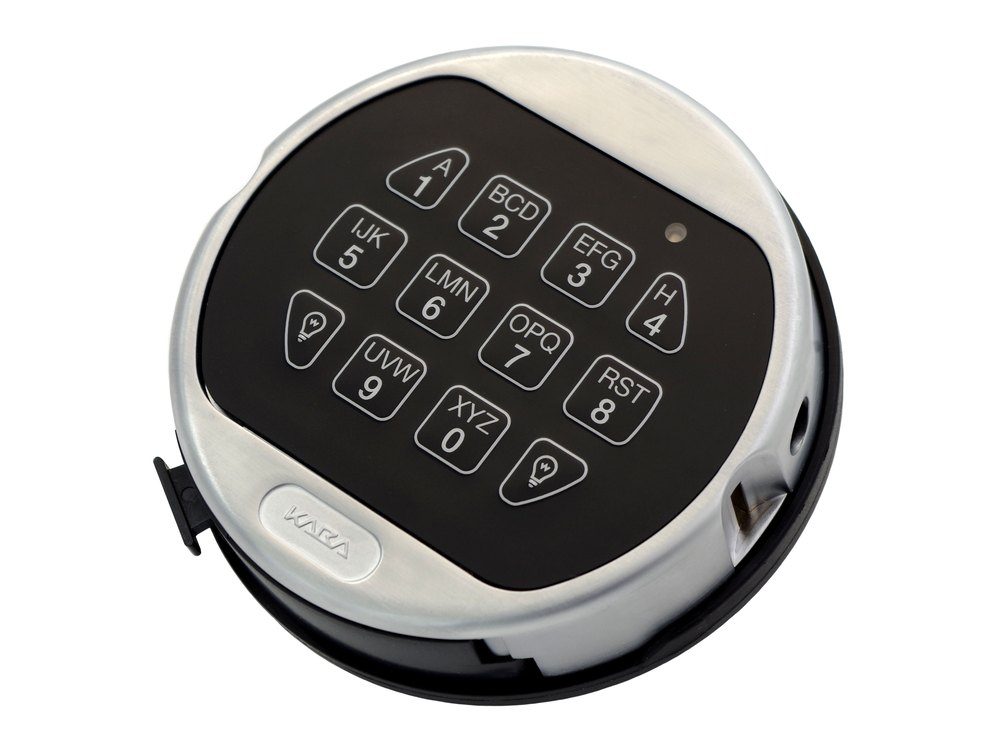
- A round keypad whose key panel sits at an angle on the safe door, with a KABA badge, number keys with letters, a small LED, and two light-bulb keys (backlight).
- It is powered by one 9-volt alkaline battery in a small battery door at the bottom of the keypad.
- 5750-K: the same keypad with a data port on the side for an eKEY token (used for auditing). The port is for data only. Never connect power to it.
- Dormakaba says these keypads work with all LA GARD electronic locks that dormakaba makes.
- Round keypads with no light-bulb keys are the 3000, 3035 or 3125: see that guide.
How to open it
- Enter your combination. (If your lock uses an eKEY, insert the eKEY and then remove it.)
- The lock gives a double signal (two LED flashes and two beeps) to confirm the combination is valid.
- Within 4 seconds, turn the keypad clockwise (dead bolt lock) or turn the handle to the open position (swing bolt lock).
- Pull the door open.
- To light up the keys, press either light-bulb key. The keys stay lit for about 8 seconds. Using the backlight with normal use does not hurt battery life.
- An invalid combination gives a triple signal (three LED flashes and three beeps).
- Dormakaba says to change the combination before you put the lock into use.
How to change the battery
The keypad uses one 9-volt alkaline battery. Change it at least once a year (we recommend Procell). Repeated LED flashing and beeping while the lock opens means the battery is low. The lock keeps its programming in permanent memory, even with the battery out.
- Open the battery door (the black plastic cover at the bottom of the keypad) by gently pulling the tab down and to the right.
- Let the battery and its leads drop down and out of the compartment. If it does not drop, pull gently on the battery.
- Unsnap the connector from the two terminals on top of the old battery. Hold on to the connector so you do not pull the wires out of the housing.
- Press and hold the 0 key for 10 seconds before you install the new battery.
- Snap the connector onto a new 9-volt alkaline battery.
- Gently push the battery and its leads all the way back into the compartment.
- Close the battery door, making sure the handle is inside the left edge of the battery opening of the keypad housing.
- Test the lock with the safe door open before you rely on it.
- If the battery door comes off completely, put it back by turning the hinge hook to the right, placing it on the battery door post of the keypad, and rotating it until the handle is inside the left edge of the opening.
How to change the combination
Always do this with the safe door OPEN.
Test the new combination several times before you close the door. Do not use a birthday or other predictable number, and do not share the combination.
- Enter your existing combination and hold down the last digit. The lock double signals, and then, about 2 to 4 seconds later, double signals again and the LED stays on. It is now ready for change commands. (With an eKEY: enter the combination, insert the eKEY, wait for the second double signal, then remove the eKEY.)
- Press 0.
- Enter your new six-digit combination two times (and the eKEY each time, if your lock uses one).
- A double signal means it worked. A triple signal means the old combination is still valid.
- If you make a mistake, wait 30 seconds and start again.
- Test the lock with the new combination several times before you close the door.
- If you use an eKEY, dormakaba says to keep the eKEY and the combination in separate places, and that setting up an eKEY should be done by an authorized person in a secure place.
Beeps and lights
| What you hear / see | What it means |
|---|---|
| Double signal (2 LED flashes, 2 beeps) | The entry was valid and accepted. |
| Double signal, then a second one 2 to 4 seconds later with the LED staying on | Change mode: the lock is ready for a combination change. |
| Triple signal (3 LED flashes, 3 beeps) | The entry was invalid. During a combination change, it means the old combination is still valid. |
| Repeated LED flashing and beeping while opening | The battery is low. Replace it right away. |
| LED flashes red every 10 seconds | The lock is in the 5-minute wrong-try penalty. |
Wrong-code lockout
Entering four invalid combinations in a row starts a 5-minute delay. The LED flashes red every 10 seconds, and any key press gives a triple signal. After the delay, two more invalid combinations start another 5 minutes.
If it still won’t open
It beeps and flashes over and over when I open it
That is the low battery warning. Replace the battery right away.
The keypad does nothing
The battery may be dead, or the lock may be in the 5-minute penalty (any key press gives three signals). Replace the 9-volt battery with a fresh alkaline one. If it is still dead, call us.
It beeped twice but the door will not open
You only have 4 seconds after the double signal to turn the keypad (dead bolt) or the handle (swing bolt). Be ready to turn right away.
Download the full manufacturer instructions
This page is a quick-reference summary. For every feature and diagram, use the official manual for your model:
- LA GARD 5750 and 5750-K User Operating Instructions (PDFs)dormakaba documents 7031.0316 (5750) and 7032.0316 (5750-K), Rev B. On dormakaba’s ComboGard Pro 39E manuals page.
- LA GARD ComboGard Pro 39E manager instructions (same page)Document 732.018 lists the 5715, 5750 and 5750-K as entry device options. Hosted by dormakaba.
Need a hand?
Still stuck? We can help.
Having a hard time getting into your safe? Our technicians are trained to open malfunctioning safes professionally, so your valuables can still be safely secured. Call us or stop by.
Steve’s Lock, Safe and Alarm · 3401 N. Sepulveda Blvd, Manhattan Beach, CA 90266
More lock guides
About this guide. This is an independent guide from Steve’s Lock, Safe and Alarm, a safe and lock dealer. Brand and model names belong to their owners and are used only to help you identify your lock. We are not affiliated with the manufacturers. These steps summarize the manufacturers’ own instructions; your lock may be a different version, so if anything here does not match what your lock does, follow your manual or call us. Always change codes with the safe door open, and test the new code several times before you close the door.
Steps last checked against the manufacturer documents on October 14, 2026.