
Safe lock help · AMSEC
Safe lock troubleshooting › AMSEC › ES1013, ES1310 and WES1310 electronic digital lock (two versions)
AMSEC’s ES1013, ES1310 and WES1310 safes have a small electronic digital lock with a turn knob, a change button on the back of the door and a bypass key lock behind the battery cover. AMSEC printed two versions of the instructions. The newer (2007 and later) sheet is for a keypad marked ELECTRONIC DIGITAL with 1 to 5, STORE, 6 to 0 and ENTER / END keys. The older (2002 to 2006) sheet is for a lock with an LCD window and a keypad with * and #. Both have two personal codes, each 2 to 6 digits. This guide covers opening, setting your codes, batteries and the bypass key for both.
Want the whole manual? Jump to the manufacturer download links.
Is this your lock?
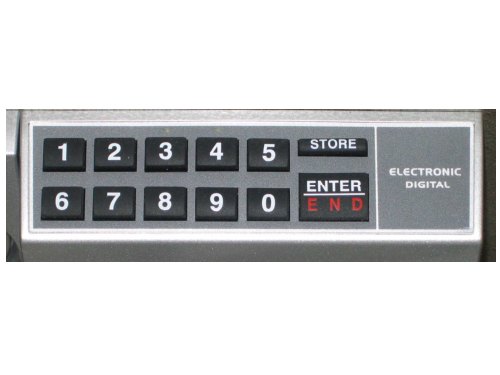
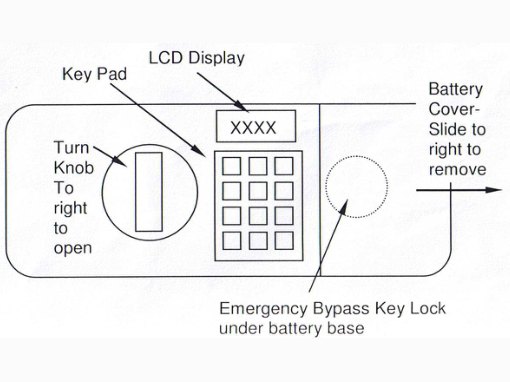
- Newer version: a small keypad labeled ELECTRONIC DIGITAL with 1 2 3 4 5 STORE over 6 7 8 9 0 ENTER/END. It has a green and a red light and a musical tone.
- Older version: an LCD window that shows messages such as OPEN, ERROR and Lo-BAT, above a keypad of 12 keys with * and #.
- Both have a turn knob and two personal codes (1st and 2nd), each 2 to 6 digits. The change button is on the back of the door, reached through a hole in the back cover.
- AMSEC’s sheets are titled “ES1013, 1310, & WES1310.” The ES149, ES1814 and WES149 safes have a different lock: see the LCD digital lock guide.
How to open it
- Newer keypad: press ENTER, then your code, then ENTER.
- After the musical tone and the green light, turn the knob to the right within 4 seconds to open the door.
Older LCD and star keypad (2002 to 2006 sheet)
- Press *, then your code, then #.
- After the signal, when OPEN appears in the display, turn the knob to the right within 4 seconds to open the door.
- A wrong number gives a tone and the red light on the newer lock, or ERROR in the display on the older one. After 3 wrong attempts the lock powers down for 5 minutes.
How to change the battery
When batteries go in, the lock does a self-check. If you get any irregular response while entering your code (on the older lock, Lo-Bat in the window), replace the batteries. Replacing the batteries does not affect your personal codes. Use a good brand of alkaline battery (we recommend Procell) and put the (+) end in each position as marked. AMSEC’s sheets do not give the battery size or count, so replace them with the same type that is in the pack.
- Newer lock: slide the battery cover to the left and take it off.
- Take out the old batteries and put in new alkaline batteries, with the + end of each as shown by the symbol in the base.
- Put the battery cover back.
Older lock (2002 to 2006 sheet)
- Slide the battery cover to the right and take it off.
- Replace the batteries with a good brand of alkaline, with the (+) end in each position of the base as shown by the symbol.
- On a new battery install, the display runs a self-check: ON, OPEN, Error, Lo-BAT, TE, good.
- First time power up (newer lock): slide the battery cover to the left and take it off, remove the protective battery tag, and the system should power up. Then put the cover back.
How to change your codes
Do this with the safe door OPEN.
The change button is on the back of the door, so the door has to be open. Try the new code before you close the door. The starting code is in AMSEC’s sheet and the paperwork with the safe. We are not printing it here.
Newer keypad: 1st (main user) code
- On the back of the door, press the change button through the hole in the back cover.
- On the front keypad, enter the new personal code (2 to 6 digits), then press ENTER.
- A green light and a musical tone mean the new code was accepted.
- Try it: press ENTER, the new code and ENTER. You should get a green light, a musical tone and a click. Turn the door knob to open.
Newer keypad: 2nd code (if you want one)
- On the back of the door, press the change button through the hole in the back cover.
- On the front keypad, press ENTER, then enter the new personal code (2 to 6 digits), then press ENTER.
- A green light and a musical tone mean the new code was accepted.
- Try it: press ENTER, the new code and ENTER. Turn the door knob to open.
Older LCD and star keypad: 1st code
- On the back of the door, press the change button.
- On the keypad press *, enter the new personal code, then press #. A signal shows it was accepted.
- Try the code before you close the door.
Older LCD and star keypad: 2nd code (only if desired)
- Press the change button.
- On the keypad press #, enter the new personal code, then press #. A signal shows it was accepted.
- Try the code before you close the door.
Lights and tones
| What you see and hear | What it means |
|---|---|
| Tone when batteries go in | The self-check passed: the batteries are good. |
| Musical tone and green light (newer) | A valid code, or a new code was accepted. Turn the knob within 4 seconds. |
| OPEN in the display (older) | A valid code. Turn the knob within 4 seconds. |
| Tone and red light (newer) or ERROR (older) | A wrong number was entered. |
| Lo-Bat in the window (older) | It is time to replace the batteries. |
| Three wrong tries | The lock powers down for 5 minutes. |
Wrong codes
After 3 wrong attempts the lock powers down for 5 minutes. Wait it out, then try again.
Emergency bypass key
There is a key lock behind the battery compartment. If the code and batteries will not open the safe:
- Newer lock: slide the battery cover to the left and take it off, then take out the batteries. Remove the two screws from the housing and carefully let the housing hang out of the way.
- Older lock: slide the cover to the right and take it off, take out the batteries, then un-snap the battery base from the clips and let it hang out of the way.
- Put one of the keys that came with the safe in the lock, turn it to the left a full rotation and hold it there, then turn the knob to the right and open the door.
- Important: before you take the key out, turn it back (to the right on the newer sheet, counterclockwise on the older sheet) until it stops. If you do not, the lock stays open and the door stays unlocked.
- If the keys are lost, the key number is stamped on the face of the cylinder. Write it down and keep it somewhere safe, not in the safe.
If it still won’t open
The keypad does not respond or acts strangely
Replace the batteries. AMSEC says an irregular response while you enter your code is the sign. Your codes are not lost when the batteries are changed.
I changed my code and now it will not open
Open the safe with the bypass key (above) and set the code again with the change button on the back of the door. Always test a new code with the door open.
The door stayed unlocked after I used the key
The key must be turned back until it stops before you take it out, or the lock stays open.
I forgot my code
Please do not keep guessing: three wrong tries power the lock down for 5 minutes. Call us.
Download the full manufacturer instructions
This page is a quick-reference summary. For every feature and diagram, use the official manual for your model:
- AMSEC ES1013, 1310 & WES1310 Operating Instructions (1/09) (PDF)The newer ENTER keypad sheet. Hosted by AMSEC.
- AMSEC ES1013, 1310 & WES1310 instructions, 2002 to 2006 (PDF)The older LCD and star keypad sheet. Hosted by AMSEC.
Need a hand?
Still stuck? We can help.
Having a hard time getting into your safe? Our technicians are trained to open malfunctioning safes professionally, so your valuables can still be safely secured. Call us or stop by.
Steve’s Lock, Safe and Alarm · 3401 N. Sepulveda Blvd, Manhattan Beach, CA 90266
More lock guides
About this guide. This is an independent guide from Steve’s Lock, Safe and Alarm, a safe and lock dealer. Brand and model names belong to their owners and are used only to help you identify your lock. We are not affiliated with the manufacturers. These steps summarize the manufacturers’ own instructions; your lock may be a different version, so if anything here does not match what your lock does, follow your manual or call us. Always change codes with the safe door open, and test the new code several times before you close the door.
Steps last checked against the manufacturer documents on October 19, 2026.