
Safe lock help · Sargent & Greenleaf
Safe lock troubleshooting › Sargent & Greenleaf › Rotarybolt Z03 (multi-user and dual control, one- or two-battery keypad)
The Sargent & Greenleaf Rotarybolt Z03 is an electronic safe lock with a round keypad on the door and a compact lock body inside. It comes in multi-user and dual-control versions and works with a keypad that takes one or two 9-volt batteries. This guide covers how to open it, change your own code, find out which mode it is in, replace the batteries, and what the beeps and the 10-minute lockout mean.
Want the whole manual? Jump to the manufacturer download links.
Is this your lock?
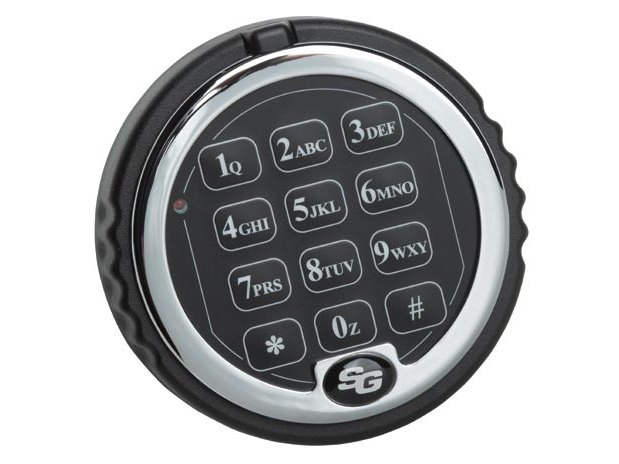
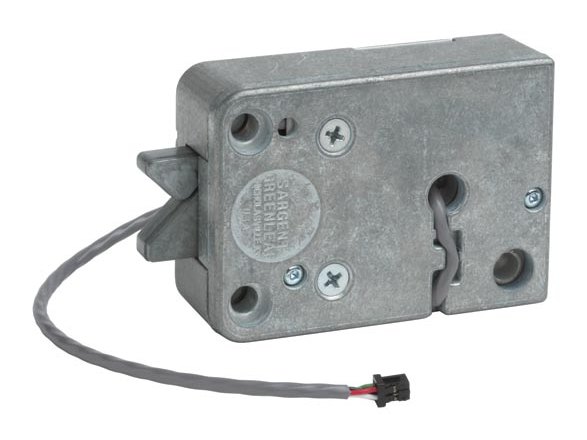
- A round keypad (keys with letters, a * and a #) on the safe door and a small lock body inside the door joined by a cable.
- Codes are six digits or six letters and end with #. S&G lists the 6120, 6130, 6160 (IP series) and 61KP keypads for it.
- The master code is code 0, the supervisor code is 1, user codes are 2 to 8 and the time delay override code is 9.
- Check the lock’s mode: press 4 3 and listen to the beeps (see below).
How to open it
- Enter a valid code followed by #.
- The lock bolt releases for six seconds. Turn the handle and open the door. Do not put pressure on the handle until after the code has been entered.
- The lock locks automatically when you close the door and turn the handle to the locked position. It gives a low then slightly higher beep when the bolt re-locks. If you do not hear it, the lock is not properly locked.
Dual control version
- Enter a valid code and #. The lock beeps four times.
- Enter a second valid code (from a different code holder) and # within one minute. The lock then releases for six seconds.
With a time delay
- Any valid code starts the delay. The lock beeps three times and then once every ten seconds.
- At the end of the delay it gives ten rapid beeps. Enter a valid code (two in dual control) to open.
- A pause of more than 10 seconds resets the entry. Press * to clear a mistake.
- If the lock beeps but will not open, the batteries may be too weak for the solenoid. Replace them. If the safe’s boltwork presses on the lock bolt, move the handle to the fully locked position and enter the code again.
- Wait for the lock to finish beeping before you press the next key.
How to change the battery
The lock uses two 9-volt alkaline batteries with the two-battery keypad (we recommend Procell) or one 9-volt with the one-battery keypad. The lock does not forget your codes during a battery change. When the batteries are low you hear twenty consecutive beeps after you enter a code, and the lock will not open until they are replaced. An early warning of five sets of two short, high-pitched beeps can come before it opens. With the two-battery keypad the lock works on one battery in an emergency, which does not harm it.
Two-battery keypad
- Remove the keypad from its base by pulling the bottom of the housing away. Support it so the wires are not pulled. Do not let it hang from the wires.
- Turn the keypad over and pull out both batteries by the bottom of each. Do not pry them with a tool.
- Push new batteries straight into the connectors, supporting the connectors so they do not bend. Watch the polarity.
- Coil the extra wire inside the housing, away from the spring clips. Line up the spring clips and push the housing back until it snaps.
- Check the master code and all user codes at least three times with the door open.
One-battery keypad
- Do the change with the safe door open. Do not take the keypad apart.
- The removable battery holder is on the bottom of the keypad base. Pull it slightly toward the front, then downward to remove it.
- The new battery rests on a spring at the bottom of the holder, with the larger contact in line with the larger opening in the top of the holder.
- Slide the holder back in until it clicks.
- If the lock makes no sound when keys are pressed but the batteries are good, a loose keypad connector may be the cause (two-battery keypad): pull the keypad off its base and check that the wire connector is seated in its receptacle.
How to change your code
Always change codes with the safe door OPEN.
The lock beeps during the steps. Always wait for it to finish before you press the next key. A long error tone means a mistake: the old code is kept. Check the new code at least three times. The factory master code is in S&G’s sheet and we are not printing it here.
Any code holder: change your own code
- Press 2 2 *.
- Enter your old code and # (five beeps).
- Enter your new code and # (three beeps), then the new code again and # (three beeps).
Find out the lock’s mode
- Press 4 3 (anyone can do this).
- You hear a first set of four beeps, then a second set that tells you the mode: 1 beep = single user, 2 beeps = multiple user, 3 beeps = dual control.
- The master code holder (position 0) and the supervisor code holder (position 1) create and delete other codes. Those steps are administrator-level, so call us.
- Use a code with letters or digits that are not a birthday or a phone number.
Beep patterns
| What you hear | What it means |
|---|---|
| One beep and an LED flash with each key | A key was accepted. |
| 1 long continuous beep | An incorrect or incomplete code. |
| 2 long continuous beeps | A code was entered during the 10-minute lockout. |
| 3 short high beeps | A code started a time delay. |
| 1 short high beep every 10 seconds | The time delay is counting down. |
| 10 short high beeps | The time delay is finished. |
| 2 short high beeps every 6 seconds | The opening window is running. |
| 5 sets of 2 short high beeps | The batteries are getting low. |
| 20 short high beeps (lock does not open) | The batteries are too low. |
| 1 low/high beep sequence | The bolt extended: the lock is locked. |
| 3 short high, 3 short low, 3 short high (twice) | Optional keypad tamper signal (see below). |
| 4 high beeps / 2 low beeps | The lock is enabled / disabled (manager/employee mode). |
Wrong-code lockout
Five incorrect codes in a row put the lock into a ten-minute lockout. You hear two long error tones if you try a code, and pressing buttons does not affect the timer. The lockout cannot be bypassed: wait ten minutes, then try again. A wrong programming sequence can also trigger it.
Optional keypad tamper signal
Some installations have a tamper-indicating keypad (S&G part 61KP-201). If the keypad is unseated or removed and put back, the lock gives an SOS warning (three short high, three short low, three short high, repeated twice) the next time you try a code, and it will not open.
When it stops, enter a valid operating code within one minute to reset the tamper signal. The lock does not work while the keypad is off its base. The standard one-battery keypad meets VdS rules if it is fitted with the provided one-way screw.
If it still won’t open
It beeps but will not open
Replace the batteries. If it still will not open, move the safe handle to the fully locked position and enter the code again (boltwork pressure). Call us if it still does not open.
No sound when I press keys
Dead batteries are the likely cause. On a two-battery keypad, also check that the wire connector is firmly seated in its receptacle.
It does nothing and gives long tones
It may be in the 10-minute lockout. Do not press anything for 10 minutes, then enter your code.
I forgot the master code
Please do not keep guessing. Your safe’s maker may be able to help with a reset code. Call us.
Download the full manufacturer instructions
This page is a quick-reference summary. For every feature and diagram, use the official manual for your model:
- S&G Rotarybolt Z03 Multi-User Operating Instructions, document 630-707 (PDF, rev. 1/2/2007)Hosted by Sargent & Greenleaf.
- S&G Rotarybolt Z03 Dual-Control Operating Instructions, document 630-708 (PDF)Hosted by Sargent & Greenleaf.
Need a hand?
Still stuck? We can help.
Having a hard time getting into your safe? Our technicians are trained to open malfunctioning safes professionally, so your valuables can still be safely secured. Call us or stop by.
Steve’s Lock, Safe and Alarm · 3401 N. Sepulveda Blvd, Manhattan Beach, CA 90266
More lock guides
About this guide. This is an independent guide from Steve’s Lock, Safe and Alarm, a safe and lock dealer. Brand and model names belong to their owners and are used only to help you identify your lock. We are not affiliated with the manufacturers. These steps summarize the manufacturers’ own instructions; your lock may be a different version, so if anything here does not match what your lock does, follow your manual or call us. Always change codes with the safe door open, and test the new code several times before you close the door.
Steps last checked against the manufacturer documents on October 20, 2026.