
Safe lock help · Mechanical
Safe lock troubleshooting › Mechanical › Dial Combination Lock
A mechanical dial combination lock has no battery and no keypad: just a dial with numbers. This guide shows how to dial a combination open correctly, how to relock, how to choose a good combination, and what to try when it will not open. It applies to Sargent & Greenleaf and similar three-wheel and four-wheel locks.
Want the whole manual? Jump to the manufacturer download links.
Is this your lock?
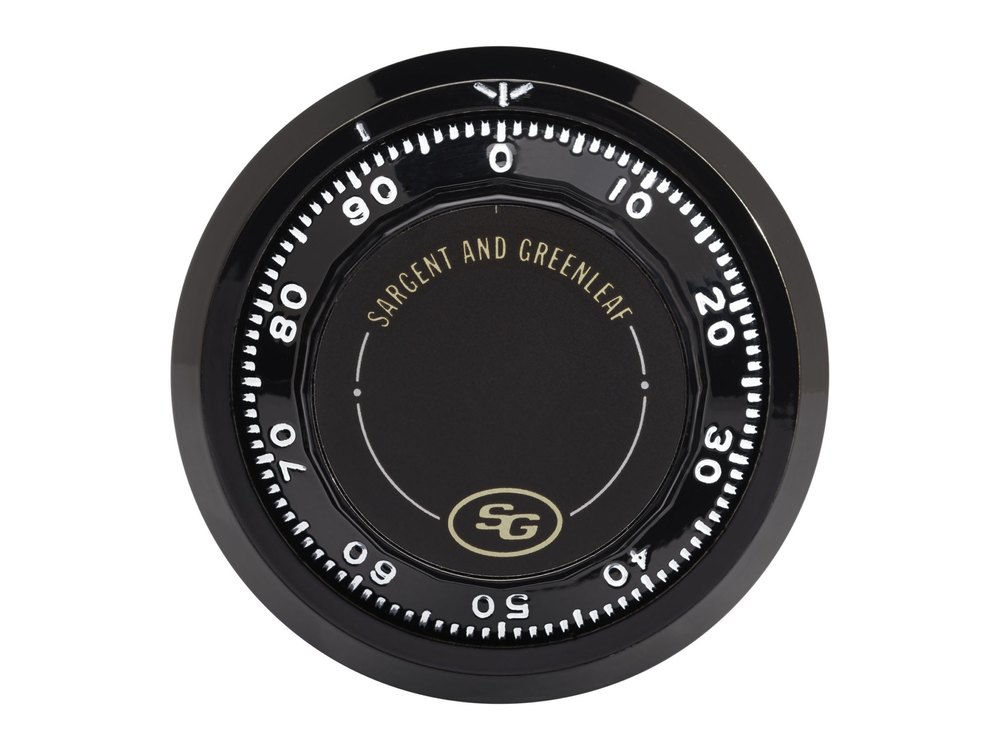
- A round dial with numbers on a ring on the safe door, and a handle you turn to open the door after the lock is dialed open.
- Most dials are front-reading (the numbers face you). Some are spy-proof dials and rings that are read from directly in front.
- The dial ring has an opening index at 12 o’clock (a mark, often shaped like a crow’s foot). A second mark at 11 o’clock, if present, is the changing index: never use it to open the lock.
- If the numbers appear on a small display and you turn the dial to power it, you have an electronic lock such as the Kaba Mas X-09, not a mechanical one.
How to dial it open
Left means counter-clockwise and right means clockwise. Each time the number you want passes under the opening index (the mark at 12 o’clock), it counts as one pass. Count the passes, not the full turns.
Three-number combination (the most common)
- Turn the dial left (counter-clockwise). Stop when the first number lines up with the opening index for the 4th time.
- Turn the dial right (clockwise). Stop when the second number lines up for the 3rd time.
- Turn the dial left. Stop when the third number lines up for the 2nd time.
- Turn the dial right until it comes to a positive stop. This is the lock opening. On Sargent & Greenleaf dials it stops near 95, and on AMSEC dial locks it stops between 88 and 92.
- Turn the safe handle and open the door.
Four-number combination
- Turn the dial right (clockwise). Stop when the first number lines up with the opening index for the 5th time.
- Turn left. Stop at the second number for the 4th time.
- Turn right. Stop at the third number for the 3rd time.
- Turn left. Stop at the fourth number for the 2nd time.
- Turn right until the dial comes to a positive stop (near 95 on S&G dials). Then open the handle.
- View the dial straight on when you dial, so each number lines up directly under the index.
- If you pass a number, do not back up. Start the whole sequence again from the beginning.
- Dial slowly and evenly. It is normal to feel more resistance each time you complete a full turn.
- Never force the dial. If the dial will not turn with light to moderate hand pressure, the lock is already open or it needs service.
How to relock it
After you close the safe door and turn the handle to the locked position, turn the dial four complete turns to scramble the lock, so it cannot be opened without the combination.
S&G says to end on a number that is not part of the combination. dormakaba says to turn LA GARD dials four complete turns to the left. Turning four complete turns to the left and stopping on a number that is not in your combination satisfies both.
Choosing a good combination
Sargent & Greenleaf’s rules for picking a new combination:
- Do not choose numbers that all end in 0 and 5. Example of a bad one: 50-15-30. A good one: 52-15-37.
- Do not choose numbers in ascending or descending order. Bad: 22-41-68. Good: 22-68-41.
- Leave at least a ten-number gap between neighboring numbers. Bad: 41-39-66. Good: 41-30-66.
- Do not use 95 to 99 or 0 to 20 as the last number: it can stop the lock from locking correctly.
- Avoid easy guesses such as birthdays, house numbers and phone numbers.
Changing the combination
Changing a mechanical combination needs a special changing tool and careful dialing with the door open, and a mistake can lock you out. It is a job for a qualified safe technician: call us to talk it over.
If it still won’t open
It will not open even though I know the numbers
Most lockouts come from small dialing errors, so try again slowly and exactly:
- Stand directly in front of the dial and use the 12 o’clock mark, not the 11 o’clock mark.
- Stop exactly on each number. Going even a little past a number means you must start over.
- Count the passes (4th, 3rd, 2nd), not the turns, and keep the directions in the right order (left, right, left, right).
- Repeat the whole sequence carefully at least two or three times before you decide something is wrong.
It takes several tries to open, or it opens only sometimes
One number may be slightly off, or the lock may be starting to wear. Call us before it gets worse. Dial locks should be serviced by a qualified safe technician about once a year, more often in dusty or humid places.
The dial feels stuck, loose or different
Do not spray oil or household lubricants into the lock, and do not take it apart. S&G warns that heavy petroleum lubricants can damage the plastic parts inside, and says the lock is a precision mechanism for a qualified safe technician to service. Call us. S&G also notes that most safe lockouts can be solved without drilling the safe, but forcing the lock makes things worse.
Download the full manufacturer instructions
This page is a quick-reference summary. For every feature and diagram, use the official manual for your model:
- Sargent & Greenleaf Mechanical Safe Lock Guide (PDF)S&G operating, changing and troubleshooting instructions for models 6730, 6735, 6738 and 6741. Hosted by S&G.
- dormakaba LA GARD: opening mechanical combination locks (support article)For LA GARD 1985, 3330, 3332, 3370 and 3390 locks. Hosted by dormakaba.
- AMSEC: dialing a three-number combinationAMSEC support article for AMSEC dial locks.
Need a hand?
Still stuck? We can help.
Having a hard time getting into your safe? Our technicians are trained to open malfunctioning safes professionally, so your valuables can still be safely secured. Call us or stop by.
Steve’s Lock, Safe and Alarm · 3401 N. Sepulveda Blvd, Manhattan Beach, CA 90266
More lock guides
About this guide. This is an independent guide from Steve’s Lock, Safe and Alarm, a safe and lock dealer. Brand and model names belong to their owners and are used only to help you identify your lock. We are not affiliated with the manufacturers. These steps summarize the manufacturers’ own instructions; your lock may be a different version, so if anything here does not match what your lock does, follow your manual or call us. Always change codes with the safe door open, and test the new code several times before you close the door.
Steps last checked against the manufacturer documents on October 14, 2026.